
By Fanuel Chinowaita
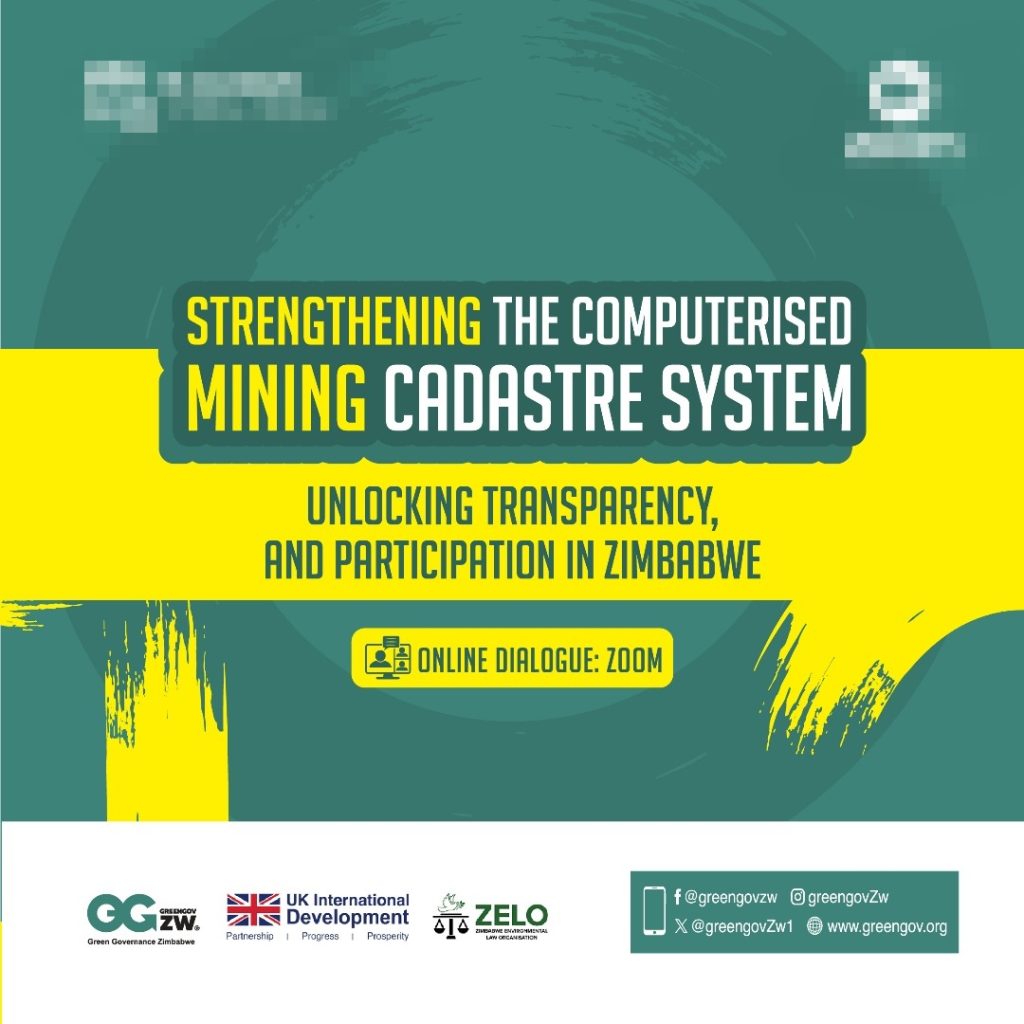
MUTARE — For decades, Zimbabwe’s mining sector has operated under a colonial-era legal framework, where paper-based records often led to double allocations, political interference and violent disputes over claims. In response, the government, alongside civil society, is pushing for a digital revolution. The vehicle for this change is the Mining Cadastre System—a computerized land information tool designed to bring transparency to the ownership, rights and restrictions tied to mining titles.
But as stakeholders gathered at the Mutare Club for a research validation meeting hosted by Green Governance Zimbabwe and the Zimbabwe Environmental Law Organisation on Monday, a complex picture emerged. While the digital system promises efficiency, its implementation is currently mired in legal ambiguity, technological exclusion and simmering conflicts between miners and their communities.
The meeting, which served as a capstone to a pilot study in Manicaland, revealed that while the blueprint for modernization exists, the foundation beneath it remains shaky.
The central tension of the day revolved around a fundamental contradiction: the Cadastre System is being rolled out without a legal mandate.
Human rights lawyer Tatenda Sigauke, a panelist at the event, delivered a stark warning about the governance gaps created by this approach. He noted that while a new bill governing the Cadastre System is yet to be passed by parliament, its implementation is already underway.
“Whatever they do must have a legal basis,” Sigauke said. “The New Bill of Mining Cadastre System has not been passed yet, but it is already implemented. This is why we still have conflicts among the ministries because they cannot implement something which has not passed yet. If it is implemented, there will be a law specifying who should do what.”
Sigauke’s comments highlighted the current incoherence between the Ministry of Mines, the Ministry of Lands and local government. Without a clear legal framework, the enforcement mechanisms that the digital system relies on remain absent, leaving miners vulnerable to overlapping jurisdictions and unresolved disputes.
Lewis Marowa of Green Governance explained that the push for the Cadastre System is an attempt to modernize the outdated 1961 Mining Act. For the past year, his organization has been working with miners, the Environmental Management Agency (EMA) and the Ministry of Mines to identify loopholes in the current system, with Mutare serving as the pilot city.
However, Frank Mpahlo, Director of Green Governance Zimbabwe, emphasized that the stakes are incredibly high. Mining accounts for roughly 70% of Zimbabwe’s national budget, making the administration of the sector a matter of national economic stability.
Mpahlo noted that while countries like Ghana and Norway have successfully implemented similar systems, Zimbabwe’s transition has been rocky. Key findings from their assessment included persistent boundary disputes, unresolved claims, and significant data migration challenges as paper records are moved to the digital platform.
“The system has potential, but without adequate resources and proper implementation, its impact will remain limited,” Mpahlo said.
He also pointed to a growing trust deficit. “There is currently low trust in governance structures and no clear social contract between communities and authorities,” he added.
While the Cadastre System is designed to attract foreign direct investment by providing a transparent record of titles, stakeholders warned that it is inadvertently squeezing the lifeblood of Zimbabwe’s gold production: small-scale miners.
Freeman Boso, one of the facilitators, highlighted the paradox of the digital shift. While the old paper system created double allocations and weak record-keeping, the new digital system is creating new forms of exclusion.
“Small-scale miners are getting out of the picture, yet they are the ones producing more gold,” Boso said.
He explained that the cost of surveys required for the digital system is prohibitively high and there is a significant digital literacy gap. Furthermore, he pointed to a dangerous precedent in land use prioritization.
“There is no clear compensation when removed from your land because now mining is treated as the first priority. If your land has a mineral, you have to move and allow mining,” Boso said.
Boso argued that the Cadastre System should be viewed not merely as a database, but as critical governance infrastructure. “If properly implemented, it can improve security of tenure, ensure a first-come, first-served allocation system, and significantly reduce disputes,” he said. However, he warned that currently, weak transparency—due to the system not being publicly accessible—allows for “elite capture” and limits accountability.
The concerns raised by panelists were echoed by miners who attended the workshop. For those operating in the hills of Penhalonga and the sprawling fields of Marange, the promise of a digital system feels distant compared to the immediate hurdles of cost and access.
“We want a system that is fair and accessible,” said one small-scale miner from Penhalonga, voicing the frustration of many. “Right now, the costs are too high and many of us don’t have the technology needed to be part of this system.”
A miner from Marange added that the system’s current trajectory risks replicating the inequalities of the past. “If the cadastre system is meant to reduce disputes, then it must include everyone. Excluding small miners and women defeats the whole purpose.”
As the validation meeting concluded, the consensus among stakeholders was clear: technology alone cannot solve governance problems. While the Cadastre System represents a significant step forward in digitizing mining records, its success hinges on the passage of enabling legislation, increased government investment and a deliberate effort to bridge the digital divide.
Green Governance and its partners called for inclusive policies that ensure the system serves not just large-scale investors, but also the artisanal miners who form the backbone of the sector.
As Mpahlo noted, the window of opportunity is open, but without a legal foundation and a commitment to inclusivity, the digital Cadastre risks becoming just another point of conflict in Zimbabwe’s complex mining landscape.